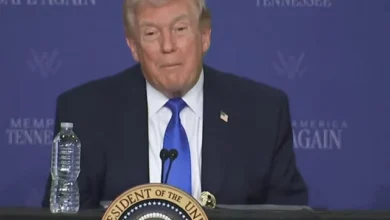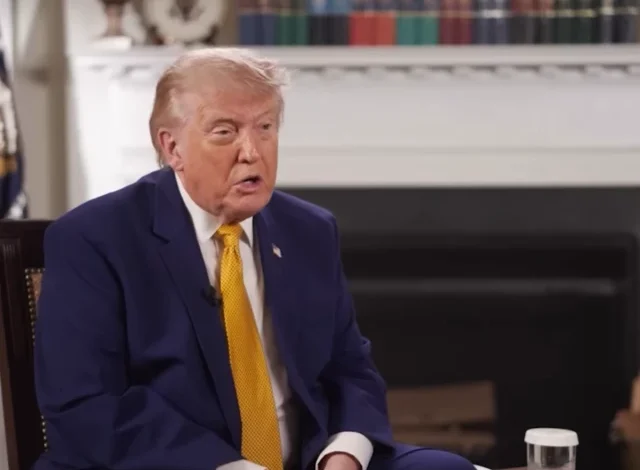
United States President Donald Trump said the US would remove high-level enriched uranium from Iran in the “near future”, and that the two countries were close to reaching an agreement.
“We will enter at some point in the near future to remove Iran’s high-level enriched uranium from the ruins,” Trump told the Financial Times on Wednesday, noting that the US would do it in coordination with Tehran.
Asked if Iran agreed to let the US get the uranium, Trump said that “they did agree”, adding, “It’s one of the things we talk about. It’s very overrated. I’m the one that overrated it. To me it’s important. To other people, it’s not important.”
Regarding the fragile ceasefire between Israel and Lebanon, Trump said he was still “trying to separate” the issue from his efforts to get a deal with Iran. Tehran demanded a cessation of Israeli attacks in Lebanon as a condition for a deal to open the Strait of Hormuz.
Trump also praised Israeli Prime Minister Benjamin Netanyahu as a “great partner”, adding that Israel “couldn’t have done [Iran war] without us, couldn’t have even come close … They needed us, and they got us to help them”.
Trump slams war-power vote as ‘meaningless’ and ‘unpatriotic’
Trump separately slammed the US House of Representatives’ vote that took place on Wednesday to block him from continuing the war against Iran.
In a Truth Social post on Thursday, he called out the “meaningless” vote that took place “right in the middle of my final negotiations to end the War with the Islamic Republic of Iran.”
“Who would do such an unpatriotic thing. They know where the negotiations stand,” he said.
For now, the vote is largely symbolic, as legislation must pass the Senate as well as the House to become effective, and there is debate over whether war powers resolutions would be constitutional even if they are approved by Congress.
The vote, nonetheless, reflects unease among some Republicans over Trump’s handling of the conflict and marks a rare bipartisan effort to curb presidential war powers as the war has entered a fourth month.
Three previous war powers resolutions had failed in the House by increasingly slim margins, and the chamber’s Republican leaders abruptly postponed a vote on this one last month when it looked likely to pass.
Iran’s Khamenei warns against divisions after ‘enemy’s defeat on battlefield’
Iranian Supreme Leader Mojtaba Khamenei said in a message on Thursday that Iran’s enemies, having been defeated on the battlefield, were now seeking to undermine public resilience and sow internal divisions.
Khamenei called for national unity in the face of those threats and said any action that created pessimism or frustration among the public amounted to helping the enemy.
The message was read on his behalf during ceremonies marking the anniversary of the death of the Islamic Republic’s founder, Ruhollah Khomeini, as well as a major Shi’ite holiday.
He said in his message that the “oppressive system” led by the United States cannot accept a strong and independent Iran and described Israel as a “fabricated outpost” of that system.
“The enemy – having failed militarily and experienced deep humiliation – now wages a hybrid war focusing on two points: the people’s endurance and miscalculations by officials. Their primary tool is sowing doubt, despair, fear, and division,” he said.
“Imperialism, led by the US, has built a military base called Israel,” he stated, adding that they “don’t accept the existence of a strong, independent Iran on the eastern border of the false, illegitimate geography of “Greater Israel”—that is, east of the Euphrates River.”
“Imperialism is willing to do anything to prevent Iran’s progress.”
Khamenei warned the Iranian people that “the enemy” had focused its hybrid warfare on sowing dissent among the Iranian populace as well as trying to create “errors in the assessments of the country’s officials.”
“The instrument it’s using for both is sowing the seeds of doubt, despair, fear, mistrust, & discord.”
He said that the enemy had received a “decisive blow” militarily and in “Iran’s public squares and streets.”
“Any action that breeds cynicism or despair among the people is a form of helping the enemy of this country and its people,” he added, urging all Iranians to respond with “steadfastness, clear-sightedness and unity”.
Era of ‘cost-free threats’ against Iran is over: Ghalibaf
Iranian Parliament Speaker Mohammad Bagher Ghalibaf said on Thursday that the era of “cost-free threats against Iran has ended”, according to the Iranian Republic News Agency (IRNA).
In a message marking the anniversary of the passing of the Ayatollah Ruhollah Khomeini, Ghalibaf reiterated Khomeini’s lessons for Iran to stand firm in the face of adversity.
“Inspired by that same school of thought, the Iranian nation has shown in its struggle against the United States and the Zionist regime that the era of cost-free threats against Iran has ended,” he said in his statement.
“Any aggression will be met with a decisive, regretful, and proportionate response.”
Lebanon, Israel agree on creating ‘pilot zones’ to place Lebanese army in control
Lebanon and Israel have agreed to renew their fragile ceasefire and establish “pilot zones” placing the Lebanese Armed Forces in exclusive territorial control, with all non-state actors excluded, according to a joint statement released on Wednesday.
“The ceasefire is contingent on a complete cessation of Hizbollah fire and the evacuation of all Hizbollah operatives from the South Litani Sector,” said the statement, which was released after the fourth round of US-mediated talks at the State Department.
The two sides agreed to “swiftly advance the creation of pilot zones in which the Lebanese Armed Forces will take exclusive control of the territory to the exclusion of all non-state actors,” the statement said.
“These steps will enable progress towards a comprehensive peace and security agreement,” it said.
Read: ‘Acting in self-defence’: FM Araghchi says strikes will continue against sites ‘used’ in attacks on Iran
The parties agreed to reconvene political and security tracks the week of June 22, with a view toward reaching a comprehensive agreement, it added.
The two countries also reaffirmed that they have “no hostile intent toward one another” and discussed a security framework which includes “the dismantlement of non-state armed groups, and the prevention of their re-emergence,” according to the statement.
The joint statement also condemned Iran’s attacks on countries in the region and its activities that “undermine stability throughout the Middle East, whether through support for proxies and all other acts of aggression.”
According to Lebanese sources speaking to Anadolu, the second and final day of the negotiations at the US State Department headquarters lasted more than six hours.
The talks follow weeks of near-daily Israeli strikes on Lebanon that have killed nearly 3,500 people since March 2, despite a ceasefire that took effect on April 17 and was later extended until early July.
The conflict recently saw an escalation as Israeli Prime Minister Benjamin Netanyahu ordered troops to deepen the incursion and called for strikes on Beirut.
Netanyahu, however, was allegedly restrained after a “tense phone exchange” with US President Donald Trump, according to media reports.
Aoun says Israel must not be given ‘pretexts’ to occupy southern Lebanon
President Joseph Aoun has met French presidential envoy Jean-Yves Le Drian at the presidential palace in Baabda, his office said in a statement, as per Al Jazeera.
“The President of the Republic emphasised the necessity of not giving Israel pretexts for not withdrawing and that every effort in this regard will have positive repercussions on the negotiations,” the statement said.
Aoun welcomed the assistance of “friendly and brotherly countries,” including France in consolidating the ceasefire.
Le Drian expressed his country’s support, solidarity and interest in Lebanese affairs, the statement added.
Lebanese President Aoun warns ceasefire deal a ‘last opportunity’ amid difficult negotiations
Lebanese President Joseph Aoun has described the latest ceasefire negotiations as difficult, according to Al Jazeera.
Speaking to journalists, Aoun said the head of the Lebanese delegation, Simon Karam, had at one point suspended participation due to what he described as Israeli intransigence, prompting US Secretary of State Marco Rubio to intervene to resume the talks.
He added that the agreement represents a “last opportunity”, warning that otherwise each side would bear its own responsibilities.
Aoun added that implementation could begin within 24 hours once all parties have approved and submitted the necessary guarantees.
Three killed in Israeli raid on Lebanon’s Bekaa Valley
Three people have so far been killed and four injured in an Israeli strike on the town of Sohmor in Lebanon’s Bekaa Valley, the state-run NNA news agency reported on Thursday, according to Al Jazeera.
A separate strike also hit Tell al-Aqareb, north of Sohmor, despite a ceasefire having been agreed between Israel and Lebanon.
Additional raids also hit the southern Lebanese towns of Haddatha, Tibnin, Haris, Kfar and Harin.
One killed as more Israeli strikes reported in southern Lebanon
Lebanon’s National News Agency is reporting more strikes in southern Lebanon, as drones fly at low altitudes over the capital, Beirut, according to Al Jazeera.
One person was killed and another wounded in Maaroub when Israeli forces targeted a motorcycle.
Israeli warplanes also targeted the towns of Zawtar al-Sharqiya, Zawtar al-Gharbiya, Shoukin, Barashit, Srifa, Kfar, Zibdin, Haris and Deir Zahrani.
Hezbollah drone strikes IDF Northern Command chief’s vehicle in southern Lebanon
A Hezbollah drone struck the vehicle of Israel’s Northern Command chief in southern Lebanon today shortly after he stepped out of it, Israel’s public broadcaster Kan reported, citing Israeli military permission for publication, as per Al Jazeera.
Major General Rafi Milo was on a field visit to a village in southern Lebanon with officers and fighters when an explosive FPV drone directly hit his vehicle. Milo and an aide had exited the vehicle shortly before impact. There were no casualties.
The incident comes amid what Israeli analysts say is a deliberate Hezbollah strategy of targeting senior IDF officers. Data published by the Amit Institute for Research and Intelligence and reported by Kan last week indicated the group has been monitoring the movements of senior Israeli officers with the aim of striking command, control and defence systems using drones, other UAVs and combined arms attacks.
Israeli defence chief hails Israel-Lebanon ceasefire as ‘great achievement’
Defence Minister Israel Katz said the US-brokered Israel-Lebanon agreement is a “great achievement in Lebanon, on the ground and also on the diplomatic level”, according to Al Jazeera.
“We promised security to the residents of the north, and we delivered,” he was quoted by Israeli media as saying. “Members of the opposition should apologise and acknowledge this.”
The defence minister added the declaration includes an “unequivocal statement” on the disarmament of Hezbollah and its removal from the area south of the Litani River.
It also allows for “the continued presence of the [Israeli military] in the security area”.
Israel threatens to strike Beirut if Hezbollah attacks
Israel Katz said a ceasefire with Lebanon grants the military the “freedom” to strike the capital Beirut if Hezbollah attacks Israeli communities, according to Al Jazeera.
“The [army] will, at this stage, continue its fire and ground operations, remain in the security zone in Lebanon up to the yellow line – including in the Beaufort area – and without the return of the population, while continuing to dismantle terrorist infrastructure on the ground,” Katz said in a statement.
Israeli forces retain the “freedom of action, with American backing, to strike in Beirut in response to fire on Israeli communities and territory”, he added.
Israel’s Benny Gantz said army must remain in Lebanon despite ceasefire
Israeli politician and former General Benny Gantz welcomed the US-brokered Israel-Lebanon agreement, saying it “could constitute a significant diplomatic breakthrough in the war against Hezbollah”, according to Al Jazeera.
“But this agreement will be tested in the reality on the ground,” Gantz said on X.
“And, therefore, the [Israeli army] must remain deployed within Lebanese territory until the full implementation of the agreement, and the state of Israel must respond aggressively to any violation by Hezbollah – even the smallest one.”
Israel’s Ben-Gvir slams Israel-Lebanon truce as a ‘serious mistake’
Hardline Israeli National Security Minister Itamar Ben-Gvir criticised the US-brokered Israel-Lebanon agreement, calling it a “serious mistake and the pipe dream of advisers who are dragging the prime minister into incorrect decisions”, according to Al Jazeera.
“Hezbollah will only grow stronger and instead of defeating it Israel is coming to terms with its very existence,” the minister said on X.
“There are moments when one must know how to say ‘no’ even to the president of the United States, and when we don’t do so we will meet Hezbollah next time when it is much stronger and more dangerous.”
Hezbollah hasn’t withdrawn from south of the Litani River, Ben-Gvir said, and he questioned the Lebanese army’s ability to enforce the agreement.
Israeli military claims it killed 2 armed individuals in Lebanon’s Beaufort Ridge
The Israeli military said its forces have achieved operational control of the Beaufort Ridge area in southern Lebanon, killing what it claims were two armed individuals in a combined air and ground attack in recent days, according to Al Jazeera.
In a post on X, it said forces from the Golani Brigade’s divisional combat team, operating under the 36th Division, identified the individuals approximately 150 metres away during an assault on the ridge adjacent to Beaufort Fortress.
The Beaufort Ridge, located near the town of Arnoun, overlooks the Israeli border and the Litani River valley, and has long been considered a strategic military position for its commanding view of southern Lebanon and northern Israel.
Hostilities continue
Earlier in the day, US President Donald Trump said he wanted to separate talks on the conflict in Lebanon and those on the war with Iran.
Tehran, however, insists the conflicts are linked and Foreign Minister Abbas Araghchi warned that any attack on Beirut would trigger a “full-scale resumption” of war.
The Israeli military said it intercepted a “hostile aircraft” and two projectiles that crossed into Israeli territory from Lebanon on Wednesday.
Hezbollah, for its part, said that “in response to the Israeli enemy army’s violation of the ceasefire”, its fighters targeted soldiers in northern Israel with a rocket barrage.
Senior Hezbollah official Mahmud Qomati had told AFP on Tuesday that the group would “not accept a partial ceasefire”.
1 paramedic killed, another wounded as Israel targets ambulance in southern Lebanon
A paramedic was killed and another wounded early on Thursday in an Israeli strike targeting a medical team in southern Lebanon, according to Lebanon’s Health Ministry.
The ministry said the Israeli military targeted an ambulance team in the town of Zebdine in the Nabatieh district.
This was the fourth Israeli army attack on paramedics and medical facilities in less than 24 hours, it added.
The latest attack occurred at a time when Israel and Lebanon agreed to extend their fragile ceasefire and create “pilot zones” that would give the Lebanese Armed Forces sole territorial control and exclude all non-state actors during US-mediated negotiations in Washington, DC, on Wednesday.
Earlier, Lebanese and Israeli officials held a fourth round of US-sponsored talks in Washington, DC, aimed at preserving the ceasefire and addressing unresolved security issues.
Israel has continued near-daily airstrikes and ground offensives in Lebanon despite a ceasefire that took effect on April 17 and was later extended until early July.
According to Lebanon’s Health Ministry, Israeli attacks since March 2 have killed 3,516 people and injured 10,674 others across the country.
Israel continues to occupy several areas in southern Lebanon, including territories held for decades as well as areas seized during the 2023-24 conflict, while its forces have also advanced several kilometres into Lebanese territory during the current hostilities.
US House passes Iran war powers resolution in rare pushback against Trump
The Republican-led US House of Representatives approved a resolution on Wednesday to block President Donald Trump from continuing the war against Iran, reflecting growing concern among members of his party about the three-month-old conflict.
The House voted 215 to 208, as four Republicans voted with Democrats in favour of the war powers resolution, which directs Trump to withdraw US troops from Iran unless Congress declares war or authorises the use of military force.
It was the latest setback for Trump in Congress despite his party’s slim majorities in both the House and Senate.
For now, the vote is largely symbolic, as legislation must pass the Senate as well as the House to become effective, and there is debate over whether war powers resolutions would be constitutional even if they are approved by Congress.
The vote, nonetheless, reflects unease among some Republicans over Trump’s handling of the conflict and marks a rare bipartisan effort to curb presidential war powers as the war has entered a fourth month. Three previous war powers resolutions had failed in the House by increasingly slim margins, and the chamber’s Republican leaders abruptly postponed a vote on this one last month when it looked likely to pass.
The Senate advanced a separate, but similar resolution last month in a procedural vote, after seven previous attempts had failed. Further votes on the Senate measure have not yet been scheduled.
The four House Republicans who voted for the war powers resolution were Representatives Tom Barrett of Michigan, Warren Davidson of Ohio, Brian Fitzpatrick of Pennsylvania and Thomas Massie of Kentucky.
No Democrats voted against it. Seven House members did not vote.
‘Ceasefire’ violations
Since the US and Israeli strikes on Iran began on February 28, Tehran has repeatedly attacked targets in the Gulf region, home to US military bases.
Hostilities have periodically flared up in recent weeks despite a ceasefire agreed in early April, as the US has pushed to reopen the Strait of Hormuz, which handled roughly a fifth of global oil and liquefied natural gas shipments before the war.
Last week, Iran and the US signalled progress towards a tentative initial agreement to halt the war and reopen the strait, but the two sides have yet to sign off on the deal, which would leave more complex negotiations for later.
Read more: Deadly drone strike on Kuwait tests shaky ceasefire
Araghchi told Lebanese broadcaster Al Mayadeen on Wednesday that talks had not been cut off, but no progress had been made.
In addition to Tehran conditioning a deal on an end to fighting in Lebanon, it also wants access to billions of dollars in oil revenue, waivers on sanctions on crude exports, a lifting of a US blockade on its ports and continued leverage over the strait.
Trump, who is under pressure to bring down fuel prices, has said his top priority is to stop Iran from acquiring nuclear weapons. Iran has maintained its atomic program is for peaceful purposes.
In a podcast interview released on Wednesday, Trump said Iran had agreed not to have a nuclear weapon and that Khamenei was involved in negotiations.
Later on Wednesday, Trump suggested there could be progress in negotiations with Iran as soon as this weekend.
“If it happens, it could happen over the weekend,” Trump told reporters in the White House’s Oval Office, without elaborating on what he expected to happen within that timeframe.
Trump said that parties were working to separate the issue of reopening the strait from the conflict in Lebanon.