A Cultural Memory Spread from the Rooftops to the Skies of Lahore۔
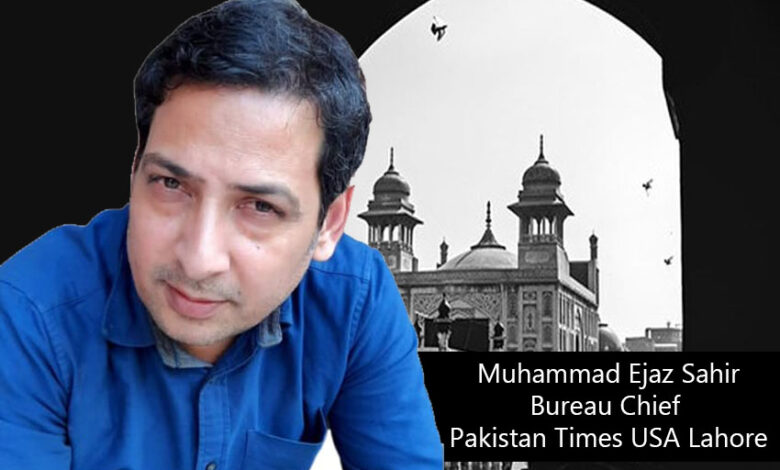
Muhammad Ejaz Sahir Bureau Chief Pakistan Times USA Lahore

Lahore is not merely the name of a city; it is a memory breathing for centuries. This memory does not reside in bricks but in the seasons themselves. The city never remains silent; sometimes it sits by the narrator and reflects, sometimes it laughs in the narrow lanes of the inner city, and sometimes, in the gentle February sunlight, it spreads colors across its rooftops.
Basant is the name of these scattered colors, so deeply woven into Lahore’s collective memory that they cannot be separated even if one wished to. Basant is not just a festival for Lahore; it is a feeling, a moment in which the city recognizes itself. After the long silence of winter, when a light mischief descends in the air, when new buds appear on the branches of trees, and when the sunlight softens, a subtle bell begins to ring inside Lahore—this is the moment when Basant is remembered.
Research shows that the roots of Basant are entwined with the ancient agrarian civilization of the Indian subcontinent. It was a time when humans were closely connected to the land, when harvests, seasonal changes, and the colors of nature were an integral part of life. Celebrating the end of winter and the arrival of spring was natural, and over time, this joy became ritual, and rituals evolved into festivals. This celebration was not restricted to a single religion, class, or era; it became a collective expression of human happiness.
During the Mughal era, Basant took on a royal hue. Lahore, then the center of culture and power, became its natural home. Historical accounts indicate that Basant was celebrated with grandeur in the courtyards of Lahore Fort, in Shalimar Gardens, and on the rooftops of the city walls. Yellow garments, music, and kite flying were part of the festival, but above all, what mattered most was togetherness. Basant established a subtle bond between the rulers and the people. In that era, Lahore’s rooftops were not just collections of bricks; they were platforms of shared joy. Every rooftop had its own story, yet the sky above was shared. Rich and poor, teachers and students, merchants and laborers—all looked toward the same sky. The sound of “boo-kaata” was not merely an announcement of victory; it was a sign that joy was being shared.
Time changed, the British era arrived, political maps were redrawn, yet Basant remained alive in Lahore’s spirit. Colonial-era newspapers, old photographs, and personal diaries testify that Basant had become a part of urban culture. Areas like Mall Road, Mozang, inner-city Lahore, Shahdara, and nearby settlements felt the breath of this festival.
After Pakistan’s independence, Basant took on a new dimension. The festival became not only a cultural celebration but also an economic activity. Kite making, string crafting, colored paper, traditional foods, and domestic tourism were all connected to it. Entire households relied on Basant for their annual livelihood. This festival did not only scatter colors in the sky; it lit hearths in homes as well.
But then came a time when greed overshadowed joy. Negligence crept into tradition, and chemical strings robbed the festival of its innocence. Lives were endangered, accidents occurred, and criticism of Basant grew. The state had to take strict measures, necessary to protect human life, yet with these decisions, silence fell over Lahore’s skies. It is important to understand that the issue was not Basant itself, but irresponsibility and mismanagement. Even today, festivals of similar nature are celebrated in many countries under strict laws, clear regulations, and technical supervision. Tradition is not ended; it is preserved.
After the ban, rooftops grew silent, the sky lost its colors, and an entire generation came to know Basant only through stories. This silence demanded that one day, serious thought would be given to understanding this cultural heritage anew. This hope is reflected in the Punjab government’s decision that February 6, 7, and 8 of 2025 would be officially dedicated to Basant. These three days are not just calendar dates; they are a careful attempt to reconcile with Lahore’s cultural memory. It acknowledges that tradition is not ended—it is preserved with understanding.
Even before official decisions, some individuals quietly labored to preserve this cultural legacy. They saw Basant not as a threat but as a responsibility. Gogi Malik, Umair Masood, Sheikh Shakeel Adil, Ustaad Javed Bhatti, Aqeel Sheikh, Ustaad Qamar Anwar, Tipu Saeen, Ustaad Bhura, Ahmad Affi Bhai Sahir, Lahori, Muhammad Ali Khokhar, and many others practically demonstrated that kite flying is an art, and joy can coexist with law and civility. They raised voices against chemical strings, introduced principles for safe kite flying, and took the initiative to keep the true spirit of the festival alive. Their efforts may not have made headlines, but in Lahore’s cultural history, their names are quietly inscribed.
The return of Basant is not merely the return of a festival; it is a matter of Lahore’s social and psychological well-being. The city has survived for centuries through festivals; joy is communal, and memories are shared. When festivals end, the city feels empty from within. In today’s fast-paced, stressful, and indifferent urban life, festivals like Basant connect humans to each other. They remind us that civilization is built not only from buildings but from traditions. And traditions demand responsibility.
Perhaps those three days in February 2025 are more than just three days on the calendar for Lahore. Perhaps they will teach us that joy can be preserved and sustained. Perhaps this time, the kites flying from Lahore’s rooftops will not only scatter colors but also send the message that this city still knows how to uphold its culture. And perhaps, after a long time, the skies of Lahore will smile once more.
About the Author
Muhammad Ejaz Sahir is a senior journalist and columnist based in Lahore. He currently serves as Bureau Chief Lahore, overseeing reporting and editorial responsibilities. His writing reflects the deep layers of Lahore’s culture, history, and human relationships.