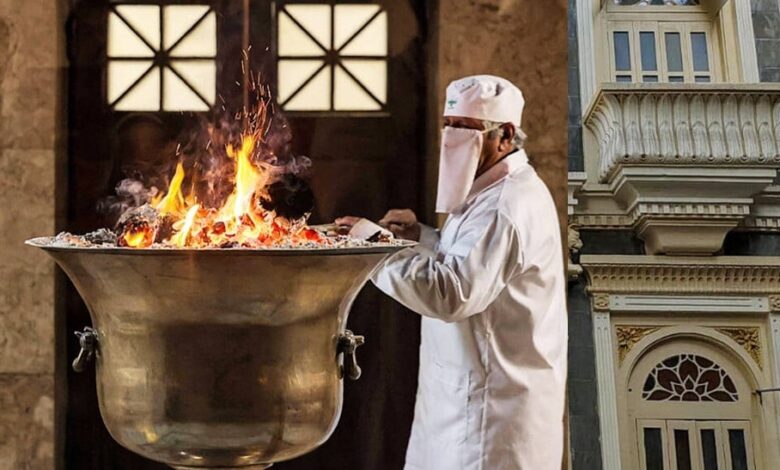
One of the smallest religious communities in Pakistan, the Zoroastrians, are more commonly known by their South Asian name, Parsis. By the most recent estimates from community leaders, there are perhaps 900 of them left in Karachi, with a few dozen more scattered across Lahore, Quetta, and Islamabad. They built much of the physical and civic fabric of modern Karachi, schools, hospitals, the city’s first elected mayor and their name is more likely to summon associations with hotel chains or old colonial era mansions.
But at the centre of their religious life sits something few people, Parsi or otherwise, have properly reckoned with: a music tradition older than Sanskrit devotional music. Transmitted not on paper but in the memory of priests, it is now closer to disappearing in Pakistan than it was ever before in its recorded history.
This is not, in the end, a story about religion. It is a story about what happens to a hymn that was never composed to be beautiful, when the last people who can produce it correctly are old, few, and without successors.
The word “Parsi” means Persian, but the community’s more accurate origin story runs through Gujarat, not Iran. After the fall of the Sasanian Empire to Arab conquest in the seventh century, Zoroastrian refugees left Persia in waves. The community’s own foundational narrative, the Qissa-i-Sanjan, a Persian poem composed in 1599 by the priest Bahman Kaikobad, describes a group of refugees who sailed from Hormuz to the Gujarati coast and were granted asylum by a local Hindu ruler, Jadi Rana, on the condition that they adopt local dress, language, and customs while retaining their faith. Historians place the actual landing anywhere between the eighth and tenth centuries; the exact date matters less than what it set in motion, eight hundred years of quiet, largely agrarian settlement in coastal Gujarat, long before the community’s fortunes changed with the rise of Bombay.
Pakistan’s Parsis are, culturally and genealogically, an extension of that Gujarati story, not a separate migration from Iran. Their visual and linguistic inheritance, the way older Parsi women still wear the gara sari, the Gujarati inflected Hindustani many speak at home, traces back to Sanjan and Navsari, not to Yazd or Shiraz. A Parsi presence in the territory that is now Pakistan is a comparatively recent, colonial era development; the first Parsi home in Karachi was built in 1844, a year after the British conquest of Sindh, and the city’s first fire temple followed in 1849. Interestingly, archaeologists have found Sasanian era silver coins at Banbhore, near modern Karachi, evidence of Zoroastrian trade contact with Sindh many centuries earlier but that is a different, disconnected thread from the community that exists today, which is Gujarati Parsi, not ancient Persian, in ancestry.
What followed was disproportionate to the community’s size. Parsis built the Mama Parsi and BVS schools, funded hospitals, and gave Karachi its first elected mayor, Jamshed Nusserwanjee Mehta, remembered to this day as “Baba-e-Karachi.” But the population curve has moved in only one direction since Partition, from just over five thousand in the 1951 census to roughly 2,800 by the mid-1990s, to under 1,500 by 2015, to the low hundreds today.
The reasons are structural rather than dramatic, emigration of the young, low birth rates, and strict endogamy (Zoroastrianism does not, in the mainstream Parsi interpretation, admit converts or the children of interfaith marriages into the priesthood or, in many cases, the fire temple itself). It is a community that is not being pushed out so much as quietly running out of arithmetic.