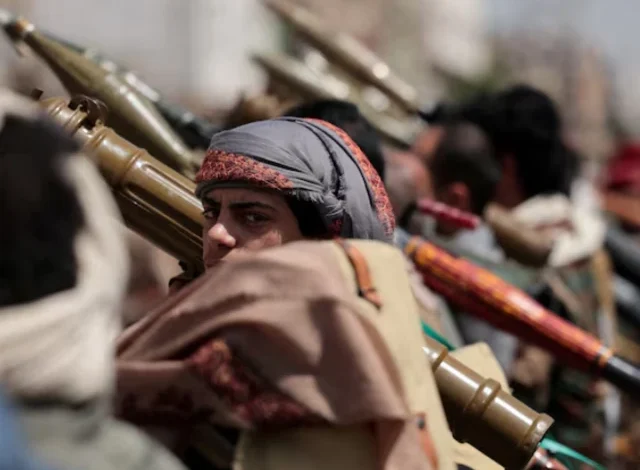
Yemen’s pro-government National Resistance Forces announced on Wednesday that one of its officers was killed during clashes with the Houthi group.
In a statement published by its 2 December news agency, the forces said Colonel Yahya Mohammed Mohsen al-Qadhi was killed in confrontations with the Houthis.
The statement did not specify where or when al-Qadhi was killed.
Al-Qadhi was buried on Tuesday in an official funeral in the western Yemeni city of Mokha before being laid to rest at the Guardians of the Republic cemetery, the statement said.
The funeral was attended by several of his comrades and leaders of the National Resistance Forces.
The statement said mourners affirmed their commitment to continue fighting under the leadership of Presidential Leadership Council Vice President Tariq Mohammed Abdullah Saleh until “all Yemeni territory is restored” and the “Houthi project” is ended.
The National Resistance Forces operate mainly in areas of Taiz and Hudaydah provinces in western Yemen.
Since April 2022, Yemen has seen a relative lull in a war that began nearly 12 years ago between government forces and the Houthis, who have controlled provinces and cities, including the capital Sanaa, since September 21, 2014.
In recent weeks, clashes have resumed between the two sides in several provinces, including Marib, Al-Jawf, Al-Dhalea and Taiz, in a country facing one of the world’s worst humanitarian and economic crises.
The Saudi-led coalition supporting legitimacy in Yemen backs government forces, while Iran is accused of supporting the Houthis, who announced in July that they had imposed a naval blockade on Saudi Arabia.
Iranian military adviser says US military ‘weaker than what we perceived’
Mohammad Reza Naqdi, adviser to Iran’s Islamic Revolutionary Guard Corps’ commander, in an interview to PBS said that the United States military was “weaker than what we perceived”.
“Up until now, we are victorious. In the future, we will continue to be victorious,” he said.
“The longer this war lasts, the more experience we gain. We had never seen a real war to gain real experience to learn how to fight with America. In these five months, we have learned how. We have also seen how the American military is weaker than what we perceived,” he added.
Vessel traffic through Strait of Hormuz falls to one-week low
Vessels tracked in the Strait of Hormuz fell to a one-week low of eight on Tuesday, shipping data showed, as owners avoided the key waterway amid continued hostilities in the Middle East, Reuters reported as per Al Jazeera.
BREAKING: Vessel traffic through Strait of Hormuz falls to one-week low
🔴 LIVE updates: https://t.co/hP7Y9IjoQ6 pic.twitter.com/olyChM5e8l
— Al Jazeera Breaking News (@AJENews) August 12, 2026
Tuesday’s tally of eight vessels fell below a 10-day average of about 12, for the lowest daily count since August 5, Kpler data showed. Only one, a coal carrier, exited the strait, while the rest were still making their way through.
New attacks on shipping as Iran war talks hit fresh impasse
The US and Yemen’s Houthis reported separate attacks on shipping on Tuesday as prospects for ending the Iran war appeared to dim, with Tehran saying the Strait of Hormuz would remain closed unless Washington accepts its conditions.
The attacks, in the Gulf of Oman leading to the strait and at the entrance to the Red Sea — both vital chokepoints for global oil supplies — come as the war shows no signs of ending despite repeated assertions from US President Donald Trump of a deal being imminent.
Oil prices gained and global shares retreated amid renewed pessimism about a quick end to the conflict. Brent crude futures climbed 1.4% to settle at $88.91 per barrel, and US crude rose 1.3% to $83.20.
At the southern end of the Red Sea, four crew members were killed in a suspected Houthi attack on a small cargo vessel in the Bab el-Mandeb Strait on Tuesday, Yemen’s Transport Ministry said. Two Yemeni rescuers from an anti-Houthi military group were also killed, Yemen’s Coast Guard said.
The fatalities aboard the Egyptian-owned Tihamah would be the first deaths on shipping by the Houthis since the Iran war began.
Read: Interior Minister Mohsin Naqvi heads to Tehran for talks amid Iran-US mediation efforts
The Houthi-affiliated news agency Saba reported that the group, which said last month it would impose a naval blockade on Saudi Arabia in the Red Sea, attacked a Saudi ship carrying military equipment in the Bab el-Mandeb Strait. It did not name the ship, and there was no immediate Saudi response to the report.
The US military, meanwhile, said a US Navy MH-60 helicopter fired two Hellfire missiles to disable the steering gear of a Panama-flagged cargo ship.
The ship ignored repeated warnings to stop violating a naval blockade on Iranian ports, the US Central Command said. Maritime sources told Reuters the ship was hit off Pakistan while sailing into the Gulf of Oman.
Stepped up rhetoric
Both Iran and the United States have stepped up rhetoric in the past two days.
Iran’s top security official, Mohsen Rezaei, said on Tuesday that the vital Strait of Hormuz shipping route will remain closed unless the US accepts Iran’s conditions to end the war – the release of Iran’s frozen assets and an end to conflicts throughout the region, including in Lebanon and Gaza.
That followed a new demand from Trump on Monday that Iran should pay compensation for people killed in 50 years of wars, attacks and protests.
Throughout the conflict, Trump has alternated between threats of escalation and claims that a peace deal is imminent.
In an interview released late on Monday, he suggested the uncertainty could last for a while, saying he might just “bop along” and let Tehran fail economically, or hit them “really, really hard.”
“I’m sort of negotiating,” Trump told Real America’s Voice. “They’re very devious negotiators.”
Read more: 3 Pakistanis among 6 killed in Houthi attack on commercial vessel in Bab al-Mandeb
Speaking to reporters after a visit to Ohio on Tuesday, Trump said “Iran is going fine, going just absolutely fine.”
“We totally control the Strait of Hormuz … Nobody else, only us,” he said.
“At some point, maybe they’ll do something and then they get blown away,” he said of Iran. “But right now, we’re in a very good position. We have a country that has been the bully of the Middle East for 50 years, really 51 if you think about it … and they’re no longer the bully of the Middle East.”
Asked about an incident in which he switched planes in Turkey last month because of worries over reports of a potential Iranian assassination threat, Trump suggested the alternative aircraft may have faced greater risk.
“That would be the plane I think that they would be more likely to go for,” he told reporters after The Washington Post broke the story about him secretly taking a military flight instead of Air Force One in an operation involving him being moved between aircraft in a catering truck.
“Any consequential president has a lot of threats,” Trump added. “I don’t worry about anything.”
The comments from Rezaei, appointed on Sunday as second-in-command of the body that coordinates Iran’s security and foreign policy, were the strongest indication the Strait of Hormuz would not reopen to shipping anytime soon. The waterway handled a fifth of global oil and liquefied natural gas flow before the war.
“As long as America does not change its behaviour and does not accept Iran’s conditions, the Strait of Hormuz will not be opened,” Rezaei said, according to the semi-official Tasnim news agency.
There was no immediate comment from Washington on Iran’s latest comments.
Thousands of people have been killed in the conflict since the US and Israel launched attacks on Iran on February 28.
Iran has struck US assets and infrastructure in countries including Oman, Jordan, Kuwait, Israel, the United Arab Emirates and Saudi Arabia.
Raising the prospect of further escalation, Mohammad Reza Naqdi, an adviser to the commander of Iran’s Revolutionary Guards, said on Iranian state TV on Tuesday that the corps was developing the ability to carry out operations “on enemy soil.”
“We need to be able to move the operations to the enemy’s soil, whenever this is needed and ordered,” he said. “This is the characteristic of the offensive doctrine that has to be attained.”
Yemen’s Houthis say dozens killed, wounded in strikes on Marib and Mokha
Yemen’s Houthi group claimed on Tuesday that missile and drone strikes targeting military sites in Marib in central Yemen and the coastal city of Mokha left dozens of people killed or injured.
Houthi military spokesman Yahya Saree said the group launched a large number of ballistic missiles and drones at military deployments, weapons depots and command centres in Mokha and the Tadawin military camp in Marib governorate.
In a statement carried by the Houthi-run Saba news agency, Saree said the targeted forces were linked to Saudi Arabia.
He also claimed the strikes hit their targets and left “dozens killed and injured,” including Saudis.
There was no immediate comment from Saudi Arabia, which maintains that it has no forces inside Yemen and says its role is limited to supporting forces aligned with the internationally recognised government and securing its borders.
Iran parliament prepares Hormuz bill to restrict ‘hostile’ vessels in Gulf
Iran’s parliament is preparing a bill on the Strait of Hormuz that would bar military and commercial vessels from countries Tehran considers “hostile” from entering the Gulf without Iranian authorisation, a senior lawmaker said.
Ibrahim Azizi, chairman of parliament’s National Security and Foreign Policy Committee, said the proposed legislation would be among Iran’s most important and advanced laws since the nationalisation of its oil industry, according to the state-run IRNA news agency.
Under the bill, military and commercial vessels belonging to “hostile” countries would not be allowed to enter the Gulf without Iran’s approval, Azizi said.
The legislation aims to strengthen Iran’s authority and control over the Strait of Hormuz, he added.
On August 9, committee spokesman Hassan Ghashghavi said the committee approved a bill aimed at securing the Strait of Hormuz and the Gulf and promoting sustainable development in both areas.
The region has remained tense since the US-Israeli war on Iran began in late February. Tehran and Washington have yet to reach a final agreement to end the confrontation, while the closure of the Strait of Hormuz continues to disrupt global energy supply chains.
Pezeshkian: Pakistan’s commitment to strengthening ties with Iran highly valued
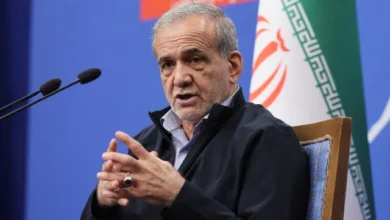
Iranian President Masoud Pezeshkian commended Pakistan’s commitment to strengthening ties with Iran, stressing Tehran’s readiness to deepen bilateral cooperation across political, economic, trade, cultural and security fields, according to IRNA.
President Pezeshkian made the remarks during a meeting with Interior Minister Syed Mohsin Raza Naqvi in Tehran on Tuesday evening, highlighting the historical, cultural and people-to-people ties between the two neighbouring countries.
The Iranian president said the commitment of Pakistan’s leadership to strengthening solidarity and expanding relations with Iran was highly valuable to Tehran.
He emphasised the need to make better use of the two countries’ existing capacities to raise the level of bilateral cooperation, saying Iran was prepared to expand ties in all areas of mutual interest.
President Pezeshkian also underlined the importance of Iran-Pakistan relations within the broader regional context. He called for stronger interaction and greater use of the available potential to expand economic, commercial, cultural and security cooperation.
According to the Iranian president, closer bilateral ties could serve the mutual interests of both nations while contributing to greater stability and security across the region.
Naqvi expressed satisfaction with his meeting with President Pezeshkian and said his visit to Tehran was aimed at following up on agreements and understandings reached during the recent visit of Iran’s Interior Minister Eskandar Momeni to Pakistan.
The Pakistani minister reaffirmed the longstanding and close relationship between the two countries, stressing that Iran-Pakistan ties were strong and unbreakable.
Naqvi said Islamabad was determined to pursue the comprehensive development of relations with Tehran.
He also emphasised the importance of implementing existing agreements and understandings, describing his visit as part of efforts to strengthen bilateral cooperation mechanisms and accelerate the implementation of commitments reached by the two sides.