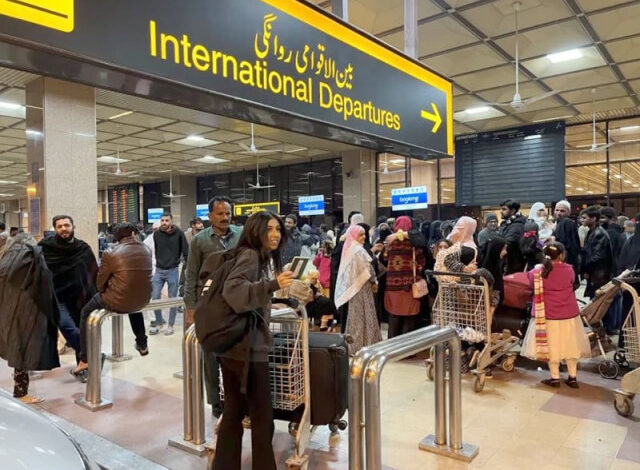
Pakistan’s international aviation sector has witnessed an unprecedented contraction in early March 2026, with international departures falling by nearly half compared to the previous month, reflecting the impact of escalating regional tensions linked to the Iran conflict and the vulnerability of Pakistan’s air travel networks to regional geopolitical shocks.
Data from the Gallup Pakistan Digital Analytics Aviation Dashboard shows that international departures dropped from 1,127 flights during February 1-10, 2026, to 572 flights in the same period of March, marking a steep 49.3% decline within a matter of weeks.
Such a decline is highly unusual and exceeds typical aviation fluctuations, which tend to show more gradual variations due to seasonal travel patterns or economic conditions. The contraction has been attributed primarily to disruptions stemming from the worsening Iran conflict, which escalated in late February.
Despite broader regional disruptions, the Pakistan Airports Authority (PAA) maintains that Pakistan’s airspace remains fully open, safe and operational for all civil aviation activity. Responding to the drop in international flights, PAA spokesperson Saifullah Khan told The Express Tribune that the decline aligns with disruptions caused by airspace closures in several Gulf and Middle Eastern countries.
“What we can confirm is that Pakistan’s airspace has remained fully open and safe throughout – no restrictions from our side. The impact has been significant on outbound routes reliant on those regional hubs, leading to cancellations and reduced traffic,” he said.
He added that authorities are coordinating with airlines and authorities for recovery efforts, including limited repatriation flights, while prioritising passenger safety. Passengers have been advised to rely on official airline updates and helplines for the latest information.
The US-Israeli aggression against Iran triggered airspace restrictions, leading to cancellations, rerouting and reduced flight frequencies on Pakistan’s international routes. Pakistan’s aviation network is particularly sensitive to such disruptions due to its reliance on Gulf transit hubs.
A large share of international flights from Pakistan connects through hubs such as Dubai, Abu Dhabi, Jeddah and Riyadh for onward travel to Europe, Asia and beyond. Temporary closures or increased risks associated with Iranian and neighbouring Gulf airspace forced airlines to suspend or adjust operations, resulting in fewer outbound flights.
Data also indicates a shift in travel patterns and route composition. In early February, departures were more evenly distributed across multiple Gulf destinations, including Dubai and Jeddah, reflecting a balance of leisure, business and religious travel.
By early March, however, flight activity became concentrated on Saudi routes, particularly Jeddah and Riyadh. This suggests that while overall travel declined, essential and religious travel, including pilgrimages, continued despite disruptions.
The nearly 50% drop in departures presents immediate challenges for Pakistan’s aviation industry, which had been recovering steadily after the pandemic. Airlines, airports and related service providers are facing revenue losses and operational constraints due to reduced flight frequencies and lower passenger volumes.
The decline in air travel may also affect tourism, trade, remittances and business connectivity, as Gulf routes remain critical for Pakistan’s economic linkages and expatriate flows. Disruptions to these routes risk delays and broader economic strain.
Gallup Pakistan data highlights how regional conflicts can quickly disrupt Pakistan’s aviation sector, underscoring the need for route diversification, stronger bilateral arrangements and improved crisis planning.
While the immediate impact of the Iran conflict remains significant, airline schedules and travel demand may stabilise gradually if airspace restrictions ease or alternative routing options become viable amid improving regional conditions.
Meanwhile, the PAA website shows that flight schedules from Islamabad International Airport as of March 18 continue to reflect largely normal departure activity, indicating that airport-level operations have remained stable despite the decline in international traffic.