A commander of Iran’s Islamic Revolutionary Guard Corps (IRGC) Aerospace Force warned the United States on Thursday against potential military action amid reports Washington was considering new strikes against Tehran.
The warning followed a report by Axios that US President Donald Trump was expected to receive a briefing from US Central Command (CENTCOM) on options for a “short and intense” series of strikes aimed at breaking the current stalemate.
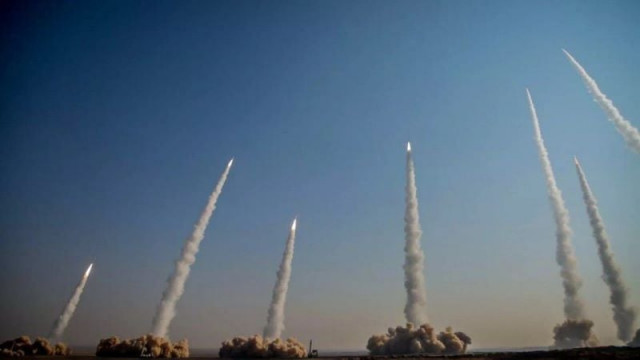
In response, Majid Mousavi, commander of the IRGC Aerospace Force, said Tehran would respond to any such operations “even if short and rapid” with “prolonged and painful blows”.
“We have seen the fate of your bases in the region; we will also see your vessels,” he added in his comments carried by the semi-official Tasnim news agency.
According to Axios, CENTCOM has prepared plans that could include strikes on Iranian infrastructure, as well as broader options such as increased naval pressure in the Strait of Hormuz.
The proposals were reportedly aimed at forcing Iran back to negotiations with greater flexibility, particularly on the nuclear issue.
The report also said Washington was considering steps to secure maritime routes in the Strait of Hormuz and was preparing for possible Iranian retaliation.
Meanwhile, an Iranian lawmaker warned that Tehran could resort to “reciprocal action” if efforts to secure war compensation through legal and financial channels failed.
Alireza Salimi, a member of the parliament’s presiding board, said in an interview with the parliament-affiliated ICANA news agency that Iran was pursuing a multi-stage strategy to claim damages following what he described as US and Israeli attacks.
He said compensation for damage to infrastructure was a key demand, but stressed that Iran’s approach went beyond financial claims.
Salimi outlined a three-step plan, beginning with legal action through international institutions to hold the “aggressor” accountable.
If those efforts proved ineffective, he said Iran would seek to recover damages by seizing assets linked to the responsible parties.
“As a final step, if neither legal action nor asset recovery yields results, Iran will pursue reciprocal action to impose equivalent costs,” he said.
Salimi also said the US should be considered a “hostile state” under international law due to what he described as violations of sovereignty without authorisation.
He added that countries allowing their territory or airspace to be used for attacks could be considered complicit and face legal claims.
Separately, Iranian President Masoud Pezeshkian said any attempt to impose a maritime blockade or restrictions in the Persian Gulf would violate international law.
“Such actions are against the interests of regional nations and global peace and stability, and are doomed to fail,” he said in a message marking Persian Gulf National Day.
A legislative plan addressing these measures was currently in its final stages following review by parliament’s judicial commission, he said.
Mojtaba Khamenei signals new Gulf chapter, calls for US exit from Hormuz
Earlier, Iranian Supreme Leader Mojtaba Khamenei said in a published written message that a new chapter for the Gulf and Strait of Hormuz was taking shape since the war on Iran by the United States and Israel broke out.
“Today, with two months having passed since the largest military campaign and aggression by the world’s tyrants in the region and the disgraceful defeat of America in its plan, a new chapter for the Persian Gulf and the Strait of Hormuz is being written,” he stated, according to Iran’s Press TV.
Iran’s supreme leader said that Tehran would secure the Gulf region and eliminate what he described as “the enemy’s abuses of the waterway,” and spoke on the continued resistance of the Iranian people against foreign aggression.
“Persian Gulf nations, long accustomed to their rulers’ silence before aggressors, have witnessed in the past 60 days the resolve of Iran’s naval forces and the IRGC, alongside the zeal and bravery of southern Iran’s people and youth in rejecting foreign domination.”
He is quoted as saying that the Gulf will have a “bright future” without the presence of the US, according to Iranian state news, and commented on the US’ inability to protect their bases and the assets of countries friendly to them.
“America’s fake bases do not have the power and ability to provide even their own security, let alone giving hope for providing security for the dependents and America-lovers of the region.”
The supreme leader added that new management of the Strait of Hormuz would bring calm, progress and economic benefits to all Gulf nations.
“The history of repeated aggression by European and American foreigners, the insecurities, losses, and numerous threats to the countries of the region, is only a part of the sinister plans of the world’s arrogant powers against the inhabitants of the Persian Gulf region,” he stated, according to Press TV.
“The legal rules and the new management of the Strait of Hormuz will bring comfort and progress for the benefit of all the nations of the region, and its economic blessings will gladden the hearts of the people.”
Russia’s Lavrov says US-Israeli conflict with Iran has ‘negative impact’ on Caspian Sea
Russian Foreign Minister Sergey Lavrov said on Thursday that the prolonged US-Israeli conflict with Iran has had a “negative impact” on the Caspian Sea and its coastline.
“The Caspian Sea must remain a zone of peace and cooperation,” Lavrov stated during a press conference following talks with Kazakh Foreign Minister Yermek Kosherbayev in the Central Asian nation’s capital Astana.
Lavrov further described a strike on Iran’s port city of Bandar Anzali last month as unacceptable, noting the seaport serves the “trade and logistics interests” of all five Caspian states.
Lavrov said that he and Kosherbayev spoke “in favour of a speedy resolution of the crisis in the Persian Gulf region and the Middle East as a whole, moving towards achieving political agreements between all parties involved.”
“When discussing the Middle East, we certainly believe it’s important not to lose sight of what’s happening in Lebanon, particularly the impasse that has developed, with no clear path out, regarding the creation of a Palestinian state,” Lavrov further said.
US, Israel responsible for ‘insecurity’ in Strait of Hormuz
Iranian President Masoud Pezeshkian blamed the US and Israel for the ongoing blockade in the Strait of Hormuz, again defending the decision to keep out “hostile countries”, according to Al Jazeera.
In a message commemorating National Persian Gulf Day on state media, Pezeskhian stated that the waterway was “a symbol of the great Iranian nation’s resistance”.
“The responsibility for any insecurity in this water area lies with the United States and the Zionist regime,” he said.
No reason to negotiate over zero enrichment: Iranian lawmaker
According to Al Jazeera, Iranian MP Manouchehr Mottaki has said if Iran had known early on that the US was seeking zero uranium enrichment, it would have shifted strategies.
“I have no objection to going to the negotiating table, but we should have looked more closely at how to proceed,” Mottaki, who represents Tehran and previously served as foreign minister, told Iran’s ISNA, as per Al Jazeera.
After the first round of talks, Mottaki said, “Trump started whispering outside about zero enrichment”, while US Ambassador to NATO Matt Whitaker did not “dare” mention it.
“If we had concluded that their final opinion was non-enrichment, naturally there would have been no point in negotiating with them, because this issue is fundamentally not related to America,” Mottaki added, according to Al Jazeera.
US seeks new international coalition to reopen Strait of Hormuz
The Trump administration is seeking to build an international coalition to restore shipping through the Strait of Hormuz as vessel traffic through the critical waterway remains stalled amid the ongoing US-Iran standoff, according to a report published on Wednesday.
The Wall Street Journal, citing an internal State Department cable sent to US embassies, reported that Washington has asked its diplomats to press foreign governments into joining a new alliance called the “Maritime Freedom Construct,” which would coordinate information sharing, diplomatic efforts and sanctions enforcement to reopen the Strait.
“Your participation will strengthen our collective ability to restore freedom of navigation and protect the global economy,” the cable reportedly says.
Read: Trump holds talks on prolonged Iran blockade
According to the report, a senior administration official confirmed the proposal as one of the many diplomatic and policy resources at the president’s disposal.
The initiative comes weeks after President Donald Trump declared the strait “COMPLETELY OPEN AND READY FOR BUSINESS,” only for ship traffic to remain largely stalled. Iran has sought to lay mines and attack tankers transiting the waterway without Tehran’s approval, while the US has enforced a blockade on all vessels heading to or from Iranian ports.
The Strait’s future has become a central sticking point in stalled peace negotiations, with Trump reportedly telling aides Monday to prepare for an extended blockade until Iran agrees to abandon its nuclear program.
Meanwhile, US Congresswoman Sara Jacobs questioned Defence Secretary Pete Hegseth about Donald Trump’s ability to be Commander-in-Chief at a Congressional session on Thursday.
“Do you believe that the president is mentally stable enough to be the Commander-in-Chief?”
Hegseth refused to “engage with the level of disparagement” that she was “putting on the Commander-in-Chief.” He did not answer her question.
US blockade ‘will fail,’ says Iran
A top military adviser to Iran’s supreme leader said that the US blockade of Iranian ports “will fail,” warning that Tehran could choose confrontation if it persists.
In remarks aired early Thursday on state television, Mohsen Rezaei said Iran has multiple ways to bypass the blockade, stressing that efforts to impose it would not succeed.
He added that if the blockade continues, Iran may resort to confrontation to break it.
Rezaei also outlined possible scenarios in the event of another war, saying it would likely focus on southern coastal areas, extending toward Isfahan, with some activity in the west of the country.
Read more: Brent oil rises 7% on report US considering military options to break Iran deadlock
He warned that such a conflict could include bombings and assassinations in Tehran.
The US and Israel launched a joint offensive on Iran on February 28, with Tehran retaliating with strikes on Israel and other regional countries hosting US assets.
The US-Israeli bombing killed more than 3,300 people before Washington and Tehran announced a two-week ceasefire on April 8 mediated by Pakistan.
While originally scheduled to expire on April 22, US President Donald Trump announced an indefinite extension of the truce on April 21 at the request of Pakistani Prime Minister Shehbaz Sharif and Chief of Army Staff Field Marshal Asim Munir.