Iranian drone attacks could disrupt the Strait of Hormuz for months, but how long the Islamic Republic could sustain its missile barrage is less clear, according to intelligence sources and military analysts.
Since the US and Israel attacked Iran on Saturday, Iran has launched hundreds of missiles and more than 1,000 drones at Gulf states allied with Washington. Most were intercepted by air defences, but some residential and commercial buildings, infrastructure and US military bases have sustained damage.
Pete Hegseth claims US is winning against Iran
United States Defence Secretary Pete Hegseth said on Wednesday that US-Israeli campaign against Iran was “just getting started”. He added that the US was winning in the war and that the US military could fight as long as needed.
“Our air defences and that of our allies have plenty of runway. We can sustain this fight easily for as long as we need to,” he told a press conference at the Pentagon.
“We are accelerating, not decelerating … More bombers and more fighters are arriving just today,” he told reporters, adding that the US would be using a “nearly unlimited” supply of 226kg (500lb), 453kg (1,000lb) and 900kg (2,000lb) bombs.
He dismissed China and Russia as non-factors in Washington’s decision making when it comes to the war against Iran.
“I don’t have a message for them, and they’re not really a factor here, and our issue is not with them,” Hegseth said, adding that the US focus was purely on ending what he called “the nuclear ambitions of Iran.”
Russia and China have longstanding diplomatic and trade ties with Iran, while Russia has close military links to the country. Both Moscow and Beijing have criticised the US-Israeli war to topple the Iranian government and destroy its military.
US submarine torpedoed Iranian warship in Indian Ocean: Pentagon
A US submarine sank an Iranian warship in the Indian Ocean, Hegseth said, touting the strike as evidence of America’s global reach in its war on Iran. “An American submarine sunk an Iranian warship that thought it was safe in international waters. Instead, it was sunk by a torpedo,” Hegseth told reporters.
Sri Lankan authorities said they had rescued 32 crew members from the frigate IRIS Dena but that 148 other sailors were missing, with hopes low that any more would be found.
Hegseth called the attack “quiet death” and the first US sinking of an enemy ship by torpedo since World War II. “Like in that war,” he said, “we are fighting to win.”
The Pentagon says one of the main aims of the US-Israeli war against Iran, launched Saturday, is to wipe out the country’s navy.
Sri Lanka’s foreign minister, Vijitha Herath, told parliament that the rescued Iranians were rushed to the main hospital in the island’s south while two navy craft and a plane were deployed to search for others.
The frigate issued a distress call at dawn on Wednesday and within less than an hour a rescue vessel reached the area about 40 kilometres (25 miles) south of the southern port of Galle, the minister said.
The frigate had completely sunk and only an oil patch remained when the navy rescue boats approached. “We are keeping up a search, but we don’t know yet what happened to the rest of the crew,” a Sri Lankan defence official told AFP.
Sri Lankan navy spokesman Buddhika Sampath said their operation was in line with Sri Lanka’s maritime obligations.
“We responded to the distress call under our international obligations, as this is within our search and rescue area in the Indian Ocean,” Sampath told AFP. “We have found a few bodies from the area where the ship had gone down,” Sampath.
Russia says US attacked Iran on false pretext
Russia accused the US on Wednesday of using an imaginary threat from Iran as a pretext to overthrow its constitutional order, and said Washington’s calls for Iranians to seize power from their leaders were cynical and inhumane.
Foreign Ministry spokeswoman Maria Zakharova said the US had used negotiations with Iran, which were taking place as recently as last week, as a cover to disguise a plan for regime change there.
Russia has a strategic partnership treaty with Iran and President Vladimir Putin has condemned what he called the cynical murder of Supreme Leader Ayatollah Ali Khamenei, who was killed on the first day of the war launched by the US and Israel on Saturday.
“There is no doubt that the imaginary, invented Iranian threat, repeatedly stated over many years, was merely a pretext for the implementation of a long-cherished plan to violently overthrow the constitutional order of a sovereign state… that Washington and Tel Aviv dislike,” Zakharova told reporters.
Without mentioning US President Donald Trump by name, Zakharova alluded to his call for Iranians to take power from the clerical leadership.
“It is even more cynical and inhumane to hear calls for the Iranians to seize power, as the West says, when the West is literally tearing ripping these hands from the Iranians,” she said.
Missile launched from Iran towards Turkiye destroyed: Ankara
A missile launched from Iran, heading towards Turkish airspace through Iraq and Syria, has been destroyed by NATO air defence systems, Turkish officials said on Wednesday.
“A ballistic munition launched from Iran, which was detected passing through Iraqi and Syrian airspace and heading towards Turkish airspace, was engaged in a timely manner by NATO air and missile defence assets stationed in the eastern Mediterranean and rendered inactive,” the defence ministry said in a statement.
“The munitions fragment that fell in the Dortyol district of Hatay province was identified as belonging to the air defence munitions that intercepted the threat after it was destroyed in the air,” the ministry said, adding there were no casualties.
“Any steps necessary to defend our territory and airspace will be taken decisively and without hesitation,” it added. “We reiterate that we reserve the right to respond to any hostile actions directed at our country.”
Turkiye warned Tehran against any steps that could spread the war after a missile launched from Iran heading toward Turkish airspace was destroyed by NATO air-defence systems, a foreign ministry source said.
Foreign Minister Hakan Fidan told his Iranian counterpart in a phone call that “any steps that could lead to the spread of conflict should be avoided”, the source added.
US-Israel intensify strikes on Iran as markets plunge across Asia
The United States and Israel pressed on with their round-the-clock assaults on Iran on Wednesday in a campaign that the top US commander said was “ahead of the game plan”. Meanwhile, death toll from US-Israeli attacks on Iran rose to 1,045, Iranian state media reported.
Even as new explosions rang out in Tehran, huge crowds of mourners were expected in the streets later on Wednesday to grieve the slain Supreme Leader Ali Khamenei, 86, killed by Israeli forces in the first assassination of a nation’s top ruler by airstrike.
But a fall in global markets turned into a rout in Asia, including a record-breaking crash in Seoul, as investors were unconvinced by US President Donald Trump’s assurances he would quickly reopen the world’s most important shipping corridor and release blockaded Middle East oil and gas.
Meanwhile, Mojtaba Khamenei, the powerful son of the late supreme leader, is alive and favoured to emerge as his father’s successor, two Iranian sources told Reuters on Wednesday.
The two sources, speaking on condition of anonymity, said Mojtaba, 56, was not in Tehran during the strike that destroyed the leader’s compound and also killed the elder Khamenei’s wife, another son and a number of senior military and leadership figures.
Iran said the Assembly of Experts that will select the new leader will announce its decision soon, only the second time it has done so since the Islamic Republic’s founding in 1979.
“The Supreme Leader will be identified in the closest opportunity, we are close to a conclusion. However the situation in the country is a war situation,” Assembly member Ayatollah Ahmad Khatami told state TV. He said the candidates had already been identified but did not name them.
Israel said it would hunt down whoever was chosen.
“Every leader appointed by the Iranian terror regime to continue and lead the plan to destroy Israel, to threaten the United States and the free world and the countries of the region, and to suppress the Iranian people — will be an unequivocal target for elimination,” Defence Minister Israel Katz said in a statement. “It does not matter what his name is or the place where he hides.”
Israel said its forces hit targets across Iran for a fifth day. An Israeli F-35 fighter jet shot down an Iranian Yak-130 over Tehran, believed to be the first time the new generation F-35 has downed a manned aircraft in combat.
Oil shock fear hits Asian tech stocks while European selloff pauses
Selling in hard-hit European shares paused on Wednesday as the focus shifted to Asia – including a record-breaking crash in Seoul, where investors dumped chipmakers on fears the widening Middle East war will create an oil price shock, raising inflation and delaying interest rate cuts.
Traders’ rush to unload different asset classes around the world has at times threatened to become chaotic this week as they process the consequences of energy prices remaining elevated for an extended period of time.
Plunges in one part of the market have spilled over into others as investors try to cover for losses elsewhere and cut down on risks.
Even safe-haven gold for example fell more than 4% on Tuesday, though it was back up 1.5% on Wednesday at $5,155 an ounce.
At the heart of it all, benchmark Brent crude was at $83.76 a barrel on Wednesday, up for a third straight day, though off its Tuesday highs, after Trump said the US Navy could escort tankers through the key Strait of Hormuz if necessary.
Ship owners and analysts were uncertain how practical that would be.
Body of Khamenei to lie in state in prayer hall
Mourners were invited to pay respects from Wednesday evening to the body of the late leader, which would lie in state at Tehran’s vast Imam Khomeini Prayer Hall, named for Khamenei’s predecessor and the founder of the Islamic Republic, Ruhollah Khomeini.
Khomeini’s grandson Hassan is also seen as a potential candidate for supreme leader, representing the more reformist wing of the leadership, suppressed under Khamenei.
But the clear favourite appears to be Mojtaba, who amassed power under his father as a senior figure in the security forces and the vast business empire they control. Choosing him would send a signal that hardliners were still firmly in charge.
Some Iranians have openly celebrated the death of Khamenei, whose security forces killed thousands of anti-government demonstrators only weeks ago in the biggest domestic unrest since the era of the revolution.
But Iranians angry with the government said there was unlikely to be much sign of protest while bombs are falling. “We have nowhere to go to protect ourselves from strikes, how can we protest?” Farah, 45, said by phone from Tehran.
The Revolutionary Guards and basiji militia “are everywhere. They will kill us. I hate this regime, but first I have to think about the safety of my two children,” he said.
Despite initial US hope for a swift and decisive ouster of Tehran’s clerical leadership, Iran kept up strikes in response against Israel and Arab Gulf states that host US bases.
Admiral Brad Cooper, the overall commander of the US campaign as head of the military’s Central Command, said 50,000 troops, 200 jets and two aircraft carriers were engaged in “24/7 strikes into Iran from seabed to space and cyberspace,” with more assets on the way.
‘Shooting what can shoot us’
Iran’s air defences had been badly degraded, its navy had no operational vessels on important waterways after 17 were sunk, and more than 2,000 Iranian targets had been hit, Cooper said in a video briefing released on Tuesday evening.
“My overall operational assessment is that we are ahead of our game plan,” he said. “In simple terms, we’re focused on shooting things that can shoot us.”
In Israel, air-raid sirens sounded warnings and buildings shook as Iranian missiles were intercepted.
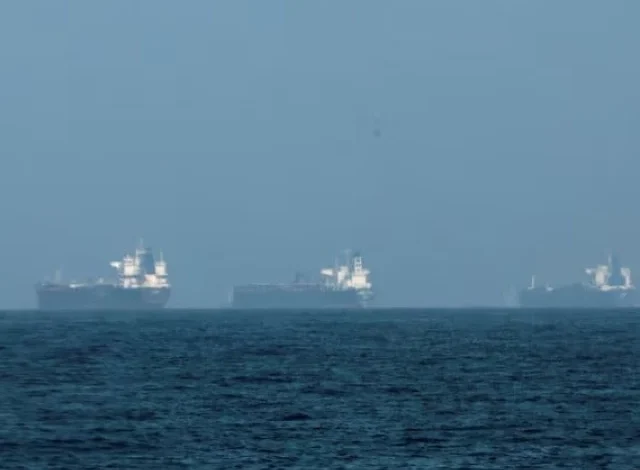
Oil prices climbed higher on Wednesday as Tehran attacked ships and energy facilities, closing navigation through the Strait of Hormuz, where a fifth of the world’s oil and liquefied natural gas are shipped close to its coast.
Scores of ships have halted in the Gulf. Qatar, one of the world’s main LNG producers, has shut production. Iraq has scaled back oil output.
The Strait is under the “full control” of Iran’s navy, the Revolutionary Guards said on Wednesday, warning vessels not to transit the waterway, the semi-official Fars news agency said.
Trump said the US Navy could begin escorting oil tankers through the Strait if necessary. But shipowners and analysts are uncertain that would be enough to stop rising prices or whether the US can spare vessels to do so without exposing them to potential attacks.
Trump risks political fallout if higher energy prices persist, as his Republican Party tries to retain power in the congressional midterm elections in November.
Iran won’t negotiate with US: senior adviser to Khamenei
Iran has no intention of negotiating with the United States and can continue the Middle East war for as long as needed, Mohammad Mokhber, a senior aide to the late supreme leader Khamenei told state TV.
He told the broadcaster that Iran had “no trust in the Americans, and we have no basis for any negotiations with them”, adding that: “We can continue the war as long as we want.”
Iran’s security chief Ali Larijani, who was also an adviser to Khamenei, said in a post on X on Monday that Tehran will not negotiate with the US, in response to a report that Iran is trying to revive negotiations with Washington.
The Israeli military said its air force shot down an Iranian fighter jet over Tehran on Wednesday, the fifth day of the Middle East war sparked by joint US-Israeli strikes on the Islamic Republic.
“The Israeli Air Force… completed an additional wave of strikes targeting the Iranian terror regime’s command centres throughout Tehran,” including internal security and paramilitary Basij sites, the statement added.
The Revolutionary Guards said Iranian forces had “complete control” of the Strait of Hormuz, a vital route for world oil and gas supplies, and any vessels seeking to pass risked damage from missiles or stray drones.
The Guards said they had also launched more than 40 missiles at US and Israeli targets in a new wave of strikes.
Governments scrambled to evacuate citizens stranded in the Middle East, where Iran expanded a retaliatory missile and drone barrage on the fifth day of a war that sent stocks sinking.
The war took a growing toll on Lebanon, where Iran-backed militant group Hezbollah has launched drones and rockets at Israel in retaliation for the killing of Iran’s supreme leader in the US-Israeli opening strikes.
Early on Wednesday, the Israeli military called on residents to leave 16 towns and villages in southern Lebanon, in an “urgent warning” before using force against Hezbollah militants.
Lebanese state media said Israeli attacks on a building killed four in Baalbek in Lebanon’s east, far from the border, as well as a Beirut hotel in an area so far spared the violence.
In Aramoun and Saadiyat — two towns south of Beirut and outside Hezbollah’s traditional strongholds — the health ministry said Israeli strikes killed six people and wounded eight. It cautioned that this was a “preliminary toll”.
It was not immediately clear what was targeted in these towns or in Baalbek, and there was no immediate comment from the Israeli military, which earlier announced “broad-scale strikes” against Hezbollah.
Israeli strikes have killed at least 52 people in Lebanon, according to the government, while the United Nations said that more than 30,000 people were displaced.
In a throwback to earlier wars, Israel said it was moving troops across the border to create a buffer zone inside Lebanon.
Read: Iran war enters fourth day in ‘smoke and blood’ as global markets slide
With global energy prices already on the rise over the expanding war, Iran’s Revolutionary Guards said it has “complete control” of the Strait of Hormuz, the crucial chokepoint into the Gulf.
But Trump said the US had “knocked out” Iran’s navy, along with its air force and radar systems, and that the US Navy was ready to escort tankers through the waterway through which one-fifth of global seaborne oil pass.
Israel’s military said it launched a “broad wave of strikes” after midnight across Iran, which in the hours before had launched three separate missile barrages at Israel, causing mild injuries to a woman in Tel Aviv.
The US military has hit nearly 2,000 targets since attacking Iran alongside Israel on Saturday, targeting ballistic missiles and “all the things that can shoot at us”, said Admiral Brad Cooper, commander of US Central Command.
“These forces bring a massive amount of firepower, representing the largest buildup by the US in the Middle East in a generation,” he said in a video message, describing the first day’s barrage as bigger than the so-called “shock and awe” against Saddam Hussein’s Iraq in 2003.
The US and Israeli attacks have killed 787 people in Iran, according to the Iranian Red Crescent a day earlier, a toll that could not be independently confirmed by AFP.
Iran vowed to inflict a heavy price in retaliation. Drones struck adjacent to the US consulate in Dubai, starting a fire but inflicting no casualties, and against the US military base at Al-Udeid in Qatar.
The attacks came a day after strikes on the US embassies in Riyadh and Kuwait City and on a US air base in Bahrain.
“We are saying to the enemy that if it decides to hit our main centres, we will hit all economic centres in the region,” Islamic Revolutionary Guard General Ebrahim Jabbari said.
The United States and Israel launched the attack on Saturday and quickly killed Iran’s supreme leader, Ayatollah Ali Khamenei, two days after US envoys had been speaking to Iran in Geneva on a nuclear accord.
He also walked back a statement the day before from Secretary of State Marco Rubio, who said the US attack’s timing was precipitated by Israel’s plans. “If anything, I might have forced Israel’s hand,” Trump said as he met German Chancellor Friedrich Merz at the White House.
Trump boasted that “just about everything’s been knocked out” in Iran, including its navy, air force and air defence, and said the attacks had killed even leaders who could have taken over.
“Most of the people we had in mind are dead,” Trump said. “Now we have another group. They may be dead also, based on reports.”
Read More: US faces missile shortages amid ongoing US-Israeli offensive on Iran: report
According to Iranian media, US and Israeli strikes targeted a building on Tuesday in the holy city of Qom belonging to the committee that is to elect a new supreme leader.
The Tasnim news agency reported that strikes had already targeted the body’s main headquarters in Tehran the day before.
Trump and Israeli Prime Minister Benjamin Netanyahu have urged Iranians to rise up, but Trump said regime change was not the goal.
The assault came weeks after Iranian authorities clamped down on mass protests, killing thousands.
In Tehran, photos showed damage to Mehrabad airport, which handles mainly domestic flights.
The Israeli military also announced a strike on an underground facility on the eastern outskirts of Tehran, where it alleged scientists were covertly working on a nuclear programme.
The United States ordered non-emergency personnel to leave embassies in much of the region. The Washington Post reported that the Iranian drone in Riyadh hit the CIA station.
The United States encouraged all Americans to leave the region if they could find commercial flights, even though air travel had been severely disrupted. The State Department said that some 9,000 Americans have found a way home.
Qatar said it had downed missiles targeting Hamad International Airport in Doha. Oman reported several drones attacking the port of Duqm, and in the UAE, falling debris from an intercepted drone caused a fire at an oil storage and trading zone, authorities said.
Also Read: Merz seeks early end to Iran war
In Tehran, residents who have not fled remained shut away in their homes for fear of the US-Israeli bombardment.
The Iranian capital is normally home to around 10 million people, but in recent days, “there are so few people that you’d think no one ever lived here”, said Samireh, a 33-year-old nurse.
Authorities had previously urged people to leave the city, and police officers, armed security forces and armoured vehicles have been stationed at main junctions, carrying out random checks on vehicles.
In the more upmarket north of Tehran, the meowing of cats and chirping of birds replaced the usual din of traffic jams.
Iranian authorities said a strike on a school in the city of Minab on the first day of the war killed more than 150 people. AFP has been unable to access the location independently to verify the toll or circumstances.
The US military began naming the first of six troops who have been killed. In Israel, nine people died on Sunday when a missile hit the town of Beit Shemesh.