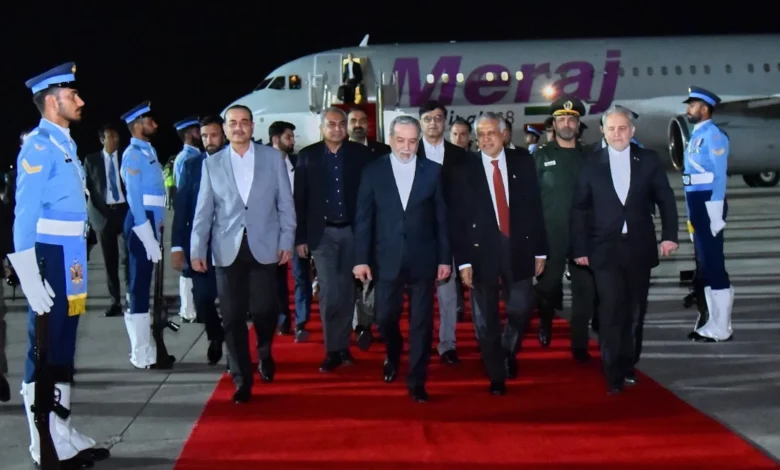
After days of uncertainty and pessimism, Islamabad is back in the diplomatic spotlight as Iranian Foreign Minister Abbas Araghchi arrived in the federal capital late Friday, signalling a renewed push to revive stalled talks between Tehran and Washington.
The high-stakes visit comes at a critical juncture, with tensions still elevated and the fate of diplomacy hanging in the balance after a planned second round of US-Iran talks in Islamabad collapsed earlier this week.
According to a statement issued by the Foreign Office, an Iranian delegation led by Araghchi was received upon arrival by Deputy Prime Minister and Foreign Minister Ishaq Dar, Chief of Army Staff Field Marshal Asim Munir, along with other senior officials.
The statement said the Iranian foreign minister will hold meetings with Pakistan’s top leadership to discuss the latest regional developments and ongoing efforts for regional peace and stability.
Diplomatic sources said the visit follows Araghchi’s separate telephonic contacts with Foreign Minister Ishaq Dar and Chief of Defence Forces Field Marshal Syed Asim Munir, part of efforts to maintain close coordination amid the evolving situation.
While Araghchi landed in Islamabad, the White House said President Donald Trump was dispatching special envoy Steve Witkoff and senior adviser Jared Kushner to Pakistan for fresh engagement with the Iranian side.
However, Tehran stopped short of confirming whether Araghchi’s visit would involve any direct or indirect talks with US officials in Islamabad.
Officials familiar with the developments said the Iranian foreign minister is expected to first consult Pakistani authorities, with the outcome likely to determine the next phase of engagement between Tehran and Washington.
In a message before departure, Araghchi said he was embarking on a “timely tour” of Islamabad, Muscat and Moscow to coordinate with key partners on bilateral ties and regional developments, emphasising that “neighbours are our priority.”
The choice of capitals reflects the broader diplomatic framework: Pakistan is seen as a key intermediary, Oman has traditionally hosted backchannel talks, while Russia remains a strategic ally of Iran, particularly on the nuclear file.
The latest developments follow the abrupt cancellation of a second round of talks that were scheduled in Islamabad earlier this week. Iran refused to send its delegation, insisting that the United States must first lift what it described as a naval blockade, a demand Washington did not accept.
At the heart of the impasse are two major issues: Iran’s nuclear programme and rising tensions in the Strait of Hormuz, a critical artery for global oil supplies.
Despite the setback, Pakistan has maintained all security arrangements put in place for the talks, and US security teams that arrived ahead of the planned meeting remain in Islamabad, an indication that diplomatic efforts are still alive.
Officials said Islamabad has been engaged in discreet backchannel diplomacy to bridge differences, with Araghchi’s visit seen as one of the outcomes of those efforts.
While both sides are struggling to agree on the next round of talks, a fragile ceasefire continues to hold after being extended by Washington without a defined timeframe.
The White House has also indicated that Vice President JD Vance remains on standby for a possible visit to Islamabad if progress is made.
Iran, however, has reiterated that it will not negotiate under pressure or coercion.
For now, all eyes are once again on Islamabad, as it attempts to leverage its role as a mediator to bring both sides back to the negotiating table.