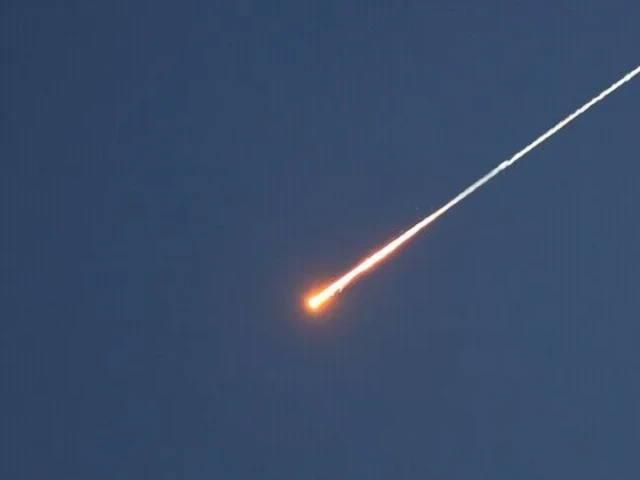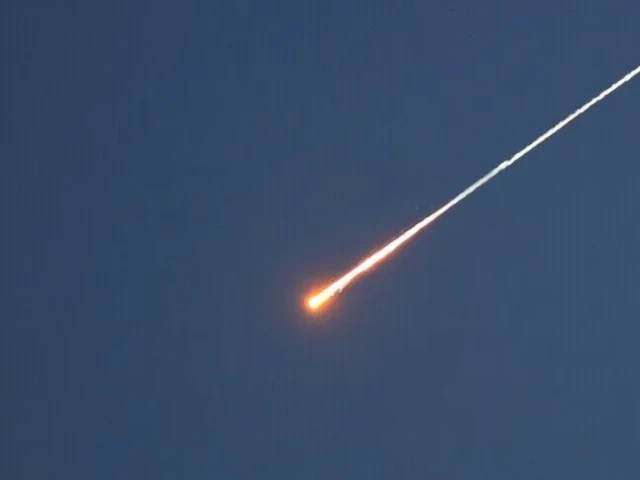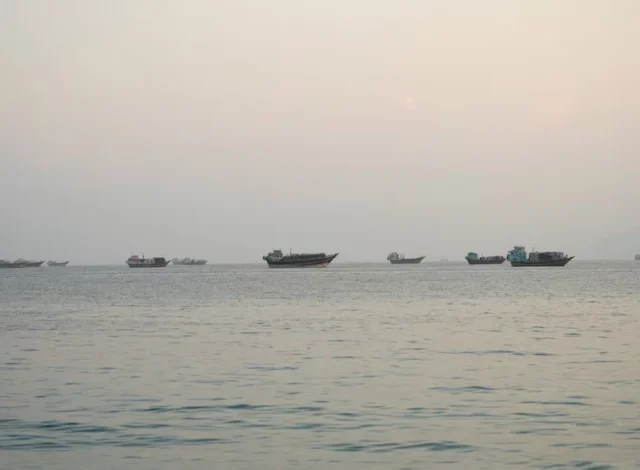
A tanker sailing outbound through the Strait of Hormuz was hit on its stern by an unidentified projectile about 11 nautical miles north of Oman’s Khasab, the United Kingdom Maritime Trade Operations (UKMTO) said on Saturday.
UKMTO later reported another incident involving a tanker hit in its engine room by an unidentified projectile 17 nautical miles east of Khasab. It was not immediately clear whether the two reports involved the same vessel.
No casualties were reported in either incident, while the environmental impact remained unknown, UKMTO said.
The incidents followed a similar attack on a tanker near Khasab on Friday that caused a fire on board, according to the British maritime security agency.
Khasab lies on Oman’s Musandam Peninsula at the entrance to the Strait of Hormuz, a strategic waterway that carried nearly one-fifth of global crude oil supplies before the US-Israeli conflict with Iran.
Shipping through the strait has been disrupted since Iran moved to close the waterway following the eruption of the conflict on February 28.
Separately, Iran’s Revolutionary Guard Corps announced that it shot down and destroyed another American MQ9 drone over the Strait of Hormuz, according to Press TV.
Iran urges world to remember 168 killed in US airstrikes on school in Minab
Iran’s mission to the UN on Friday urged the international community to remember the children killed in US airstrikes on an Iranian school on February 28 and draw attention to the suffering of survivors.
In a statement on US social media platform X marking World Children’s Day, the mission said 168 children and teachers were killed in two US airstrikes on the school in the city of Minab.
“Let’s give voice to the suffering of Minab’s innocent children. Let’s honour the memory of them,” the mission said.
It also highlighted the plight of approximately 300 students who survived the attacks but continue to suffer severe psychological trauma, requiring long-term care, treatment, and support.
“The people of Iran will never forget the tragedy of Minab’s children, whose lives were brutally taken in US airstrikes,” it added.
Read: Probe points to possible US role in Iran school strike
A UN-backed fact-finding mission recently said there were reasonable grounds to believe that the US had committed war crimes in the two Tomahawk airstrikes in Iran, including one that struck the school in Minab.
US Defence Secretary Pete Hegseth previously said the Pentagon was investigating the incident but gave no details on accountability or a timeline.
The children killed in the strikes were reportedly between the ages of 7 and 12.
The airstrikes took place on February 28, the first day of the US war on Iran, which continues to this day.
US sanctions Iranian oil traders, government insiders over alleged oil revenue scheme
The US Treasury Department announced new sanctions Friday against Iranian oil traders and government-linked facilitators it accused of helping Tehran sell oil abroad and pocketing the revenue.
The Treasury Department said the action was part of Operation Economic Outcast and was imposed under two executive orders: one targeting Iran’s petroleum, petrochemical, and aviation sectors, and the other targeting a counterterrorism authority.
“Iran’s tyrannical regime never fails to put its own interests before those of its own citizens, even as ordinary Iranians face shortages of bread and fuel,” said Treasury Secretary Scott Bessent. “The regime has exhausted its seaborne oil supply, and it may never see the revenue from the oil it has already sold. The ship is sinking.”
The department said no oil has been loaded onto vessels since the operation began and none is on the water outside the US military blockade imposed during the months-long ongoing war, as the Iranian government tries to recoup billions of dollars from oil trustees.
It said Mohammad Javad Bavand, a former Islamic Revolutionary Guard Corps (IRGC) intelligence officer, and Majid Taj, brother of the head of the Iranian Football Federation, lead a network selling oil from Iran’s dwindling reserves despite owing billions of dollars to the government.
Read more: Trump says Iran won’t make a deal acceptable to him
Mohammadhossein Servati, the son of IRGC Brigadier General Mohsen Servati, and Mojtaba Arabnejad, the son of Mahan Air CEO Hamid Arabnejad, were also designated.
The department claimed that Servati held executive roles at companies run by Sepehr Energy Jahan Nama Pars Company, a US-designated front company, while Arabnejad allegedly bought aircraft parts and procured weapons for the Iranian military.
Separately, the US State Department said that the four designated individuals illicitly sell oil to help fund Iran’s military and its support for terrorism. It described Mahan Air as an airline Iran uses to move weapons and fighters for the IRGC-Quds Force.
The Treasury Department said the US will keep working to deny Tehran the revenue it uses to destabilise the region and threaten US partners.
Araghchi says Iran wants diplomacy to end war, Trump says terms unacceptable
Iran’s Foreign Minister Abbas Araghchi said Tehran still hoped diplomacy could end its war with the United States, while US President Donald Trump said Iran wanted a deal but one that was not acceptable to him.
Araghchi told the state-owned Iran newspaper that messages continued to be exchanged between Iran and Washington through mediators, and that Tehran was seeking “an agreement that would ensure there was no further war”.
He also said Iran wanted guarantees that Washington was serious about negotiations before proceeding further, adding that Iran had discussed with mediators the form and nature of confidence-building measures.
The remarks came as diplomatic efforts continued to try to end a conflict that has destabilised the Middle East, disrupted shipping, driven up global energy prices and drawn in countries across the region.
The foreign minister said Iran’s red lines included keeping its highly enriched uranium in the country, though he said a “fair solution” was still possible.
Authorities have previously mentioned “feasible formulas” to resolve the dispute between Tehran and Washington over the matter, including diluting the highly enriched uranium stockpile under the supervision of the International Atomic Energy Agency.
The IAEA estimates that Iran had 440.9 kg of uranium enriched to 60% when Israel and the US attacked Iranian nuclear facilities in June 2025. How much of that has survived is unclear.
“I believe a fair solution can be reached on the issue of nuclear material, one that is based on our national interests while also meeting the country’s needs,” Araghchi said.
Trump, in a press conference on Friday, said: “They want to make a deal, but they don’t want to make a deal that’s acceptable to me.”
The United States and Israel attacked Iran on February 28, prompting Tehran to retaliate against Israel and Gulf states hosting US military bases.
Qatari and Iranian officials met on Tuesday in talks aimed at “bridging perspectives and narrowing the gap between proposals presented on the ground,” a spokesperson for Qatar’s foreign ministry said.